
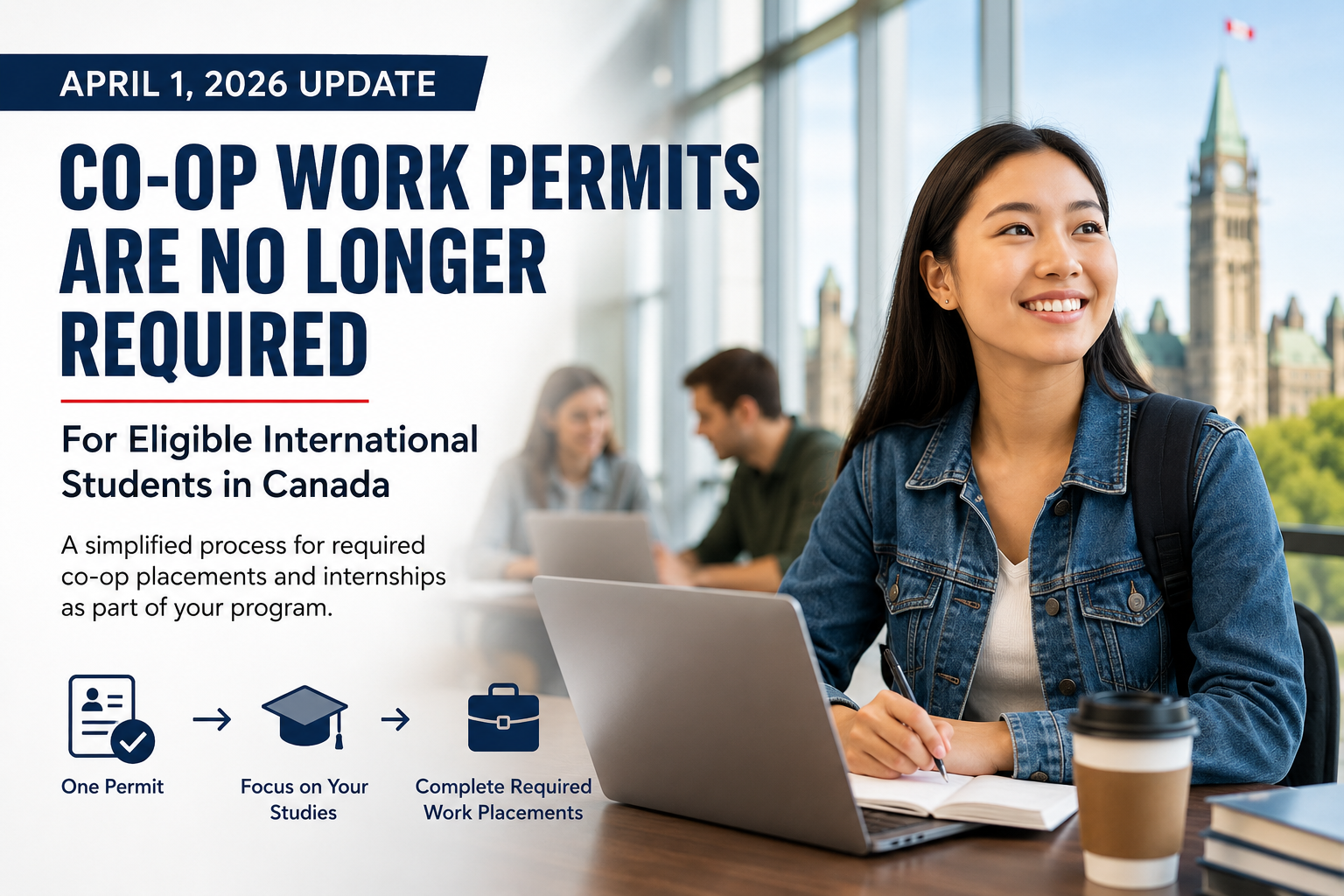
For many international students in Canada, a co-op placement or internship is an important part of their education. In some programs, completing a work placement is not optional—it is a requirement for graduation.
Until recently, international students generally needed to apply for a separate co-op work permit before beginning a mandatory work placement. As of April 1, 2026, this requirement has changed for eligible post-secondary international students.
What changed on April 1, 2026?
Immigration, Refugees and Citizenship Canada (IRCC) announced that eligible post-secondary international students no longer need a separate work permit to participate in a work placement that is required as part of their program.
This may include:
- co-op placements;
- internships; and
- other required work placements that form part of an eligible post-secondary program.
Eligible students may now complete these required work placements under their study permit, provided the employer is approved by their designated learning institution (DLI) and the applicable requirements are met.
In practical terms, this means that many eligible students can complete both the academic and required work components of their program without applying for a separate co-op work permit.
Why is this change important?
Previously, a student could have a valid study permit but still need to wait for a separate co-op work permit before beginning a mandatory placement.
This created an additional application process and, in some cases, uncertainty about whether a student would receive the required authorization in time to begin their placement.
The new approach is intended to simplify the process. Instead of requiring separate permits for the study and mandatory work components of a single program, eligible students may now complete the required placement under their existing authorization.
However, this change does not mean that all international students can work without restrictions.
Does this mean international students can work anywhere?
No.
The change applies to eligible post-secondary international students completing work placements that are required as part of their program. The employer must also be approved by the student’s designated learning institution.
This is different from general off-campus work or other employment that is unrelated to a required program placement.
Students should not assume that every internship, volunteer opportunity, practicum, or job is automatically covered by this change. The nature of the work, the requirements of the academic program, the student’s immigration status, and the conditions attached to their study permit may all be relevant.
What if you already applied for a co-op work permit?
According to IRCC, eligible international students with an active co-op work permit application that is still awaiting a decision do not need to take any action.
IRCC has stated that eligible and active co-op work permit applications will be withdrawn.
If you have a pending application, it is still important to review your individual circumstances and any communication you receive from IRCC.
What should students do before starting a placement?
Even though a separate co-op work permit may no longer be required for eligible students, you should confirm that you meet the applicable requirements before beginning work.
You may need to confirm:
that you are an eligible post-secondary international student;
that the work placement is required as part of your program;
that your designated learning institution has approved the employer;
that your study permit and temporary resident status remain valid; and
that you continue to meet any other applicable immigration requirements.
Do not assume that a placement is authorized simply because it is connected to your field of study.
What does this mean for future international students?
For eligible students, this change may make programs with mandatory co-op or internship components easier to navigate from an immigration perspective.
However, choosing a school or program should still involve careful planning. Your study permit, the eligibility of your institution and program, your ability to complete required work placements, and your longer-term goals in Canada should all be considered together.
Immigration rules can also change. Information that applied when you first researched a program may not be the same by the time you begin your studies or your work placement.
Before you start your co-op or internship
The removal of the separate co-op work permit requirement is an important simplification for eligible post-secondary international students. However, it does not remove all immigration requirements related to working in Canada.
Before beginning a required placement, make sure you understand whether the new rules apply to you and whether your proposed employment is properly authorized.
If you are unsure how the April 2026 changes affect your study permit, co-op placement, or overall immigration plan, professional advice based on your individual circumstances may help you understand your options and avoid problems with your status in Canada.
The information in this article is current as of the date of publication and is provided for general informational purposes only. Immigration laws, regulations, policies, and program requirements may change without notice. This article does not constitute legal advice. For advice specific to your circumstances, please contact me to book a consultation.